
[Grand Prix collection] A model with the achievement of competing in the 1976 F1 and achieving a 1-2 finish in the Swedish GP! The popular Tyrrell P34 1976 Japan GP is now available as a model!
[Grand Prix collection] A model with the achievement of competing in the 1976 F1 and achieving a 1-2 finish in the Swedish GP! The popular Tyrrell P34 1976 Japan GP is now available as a model!
2026-09-26
[Grand Prix collection] A model with the achievement of competing in the 1976 F1 and achieving a 1-2 finish in the Swedish GP!
The popular Tyrrell P34 1976 Japan GP,
which drew attention even at Fuji Speedway,
the site of Japan's first F1 race, is now available as a model!
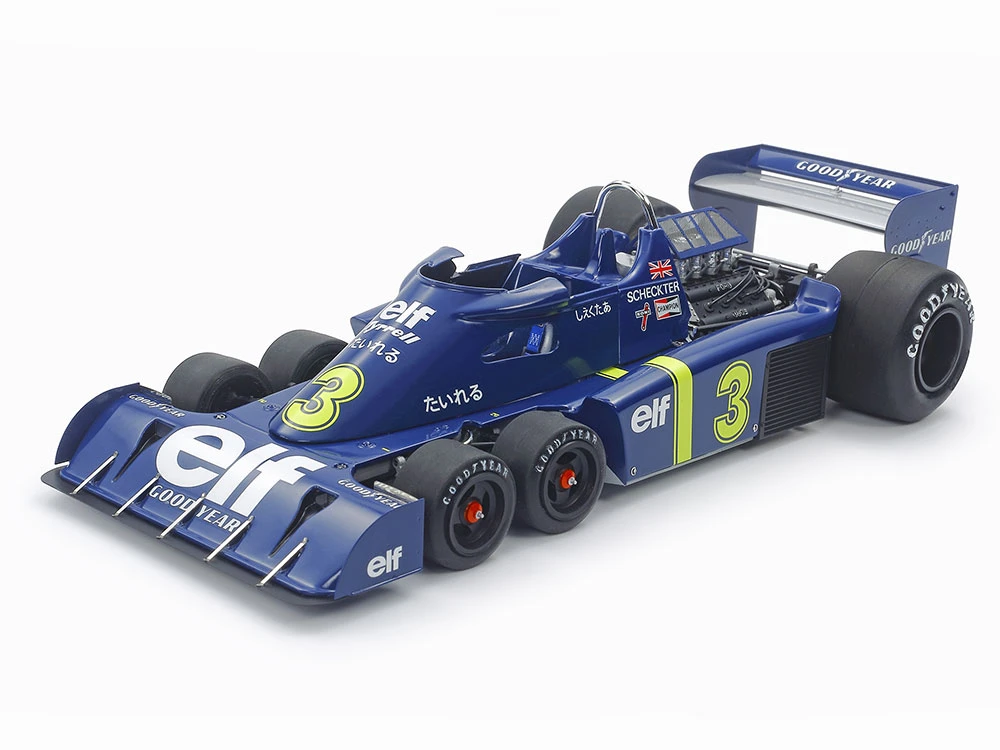
When you hear of an F1 car, it has four tires. The machine that overturned that common sense head-on is the ”Tyrrell P34.” Its appearance, with four small-diameter tires in the front and two in the rear, is amazingly unique even when viewed today. You might think, ”Wasn't it just giving shape to a bizarre idea?”, but the interest of this machine lies in the fact that it was also fast. Introduced to F1 in 1976, it achieved a 1-2 finish at the Swedish GP. And in the same year, it also appeared in the first F1 race held in Japan. The ”1/20 Tyrrell P34 1976 Japan GP” allows you to enjoy that historic Japan GP specification on a 1/20 scale. Just looking at it as a model is distinctive, but the more you know about the background of the actual car, the more it makes you feel that ”there was a meaning to these six wheels.”
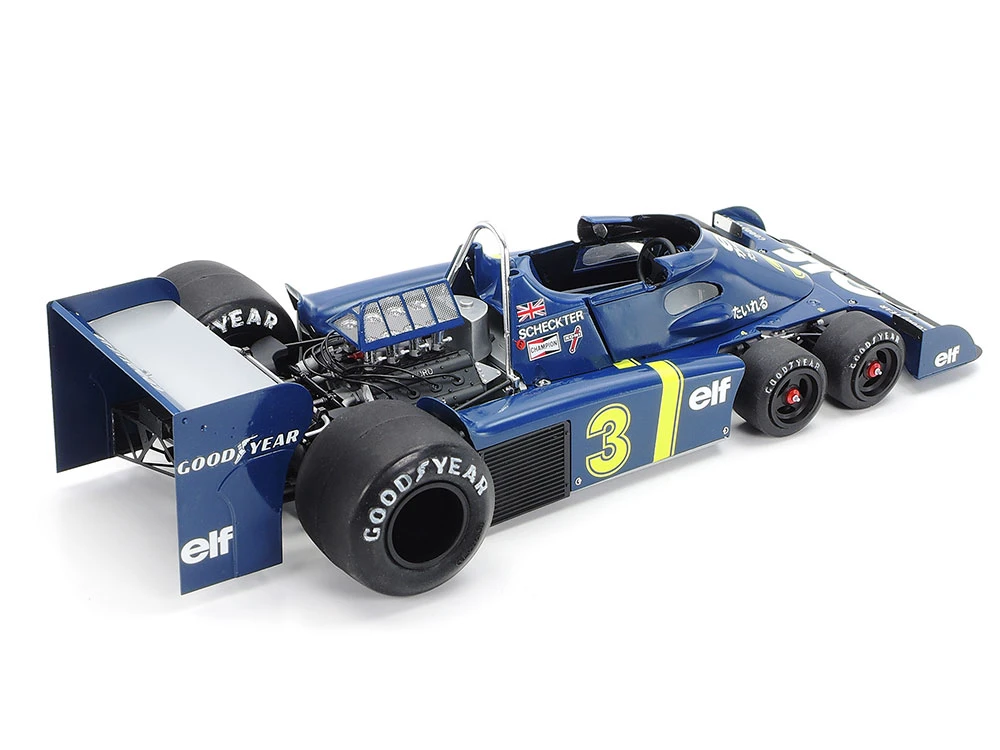
Driving the Tyrrell P34 in the 1976 Japan GP were J. Scheckter and P. Depailler. In qualifying, Scheckter finished 5th and Depailler 13th, but the story moved significantly in the rain-plagued final race. Depailler showed a fierce push under bad conditions, driving well enough to temporarily take the lead. After that, it became a difficult situation where the track surface gradually dried up, and in the final stage, a rain tire burst. Despite being hit by an accident that dropped his position, he drove through to the end and finished in 2nd place following M. Andretti's Lotus. In other words, what this model reproduces is not just a ”rare six-wheeled car.” It is the machine that gained a podium finish while being at the mercy of rain and changing road conditions on the stage that marked the beginning of Japanese F1 history. Standing in front of the completed model, you will want to imagine even the turbulent race that unfolded at Fuji Speedway.
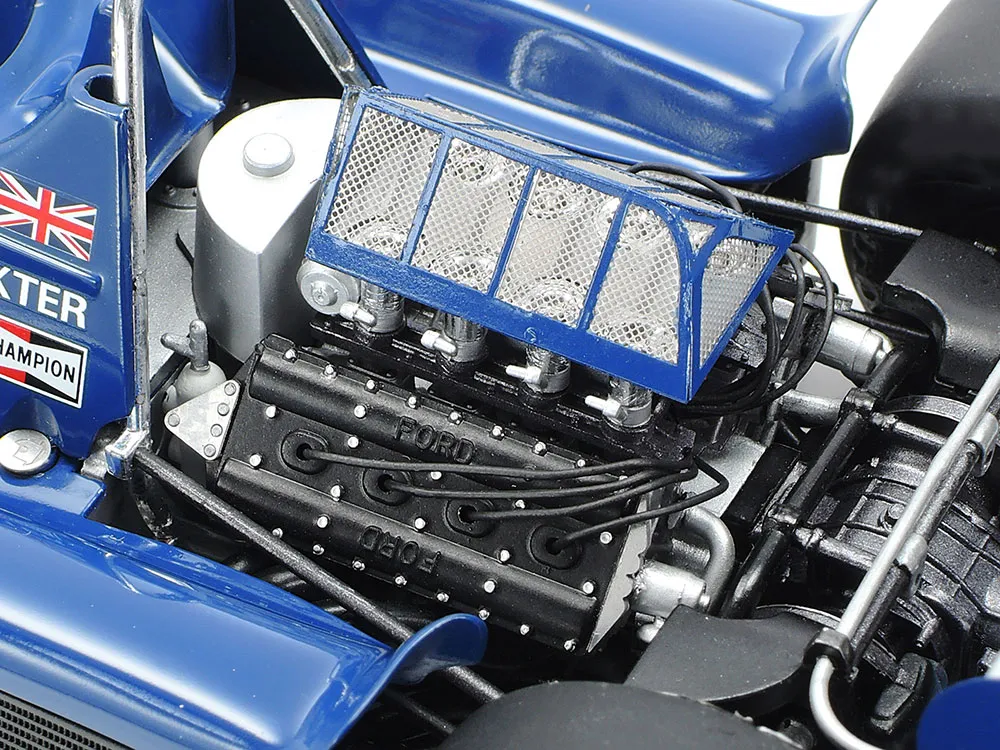
The completed size of the kit is 201mm in total length and 100mm in total width. Along with the unique proportion of four front wheels and two rear wheels, which is the biggest highlight, you also want to pay attention to the interior and undercarriage. The DFV engine has a dense configuration wired up to the ignition cords, and the front suspension that symbolizes the P34 is also precisely modeled. Looking at the car body from above to enjoy the silhouette unique to six wheels is fine, but dropping your gaze slightly to observe the mechanical parts changes the impression completely. You can enjoy reading the design philosophy of the actual car from the model, thinking ”So it has this kind of structure.” The assembly process itself becoming a time to learn the structure of the special racing car called P34 is also the real pleasure unique to this kit.
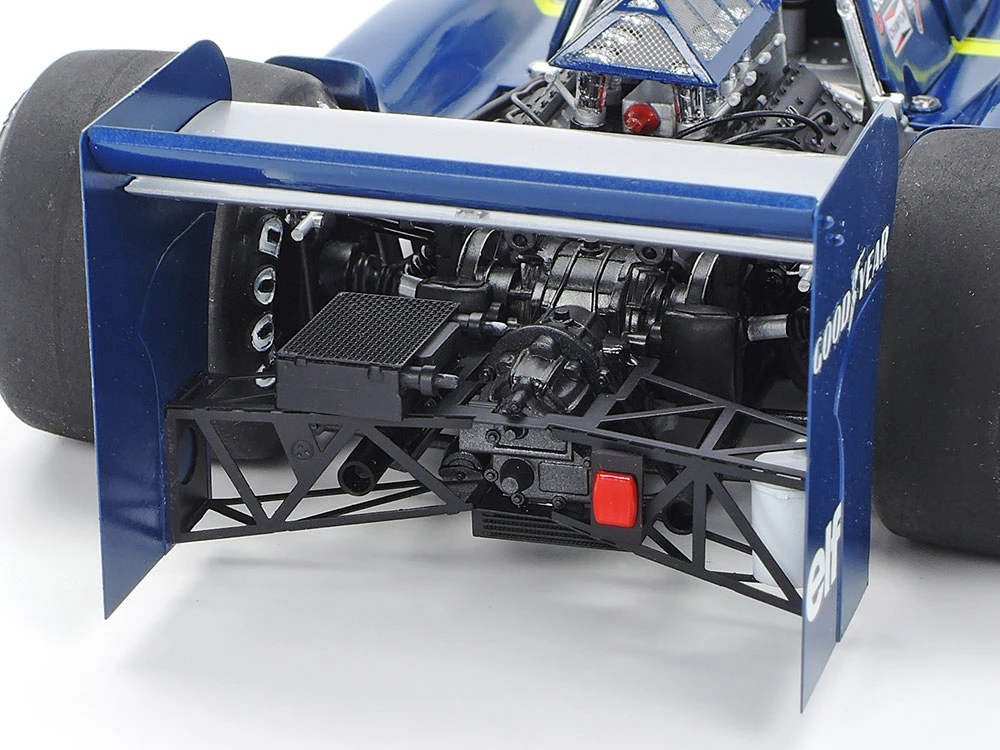
What tickles your heart further are the markings unique to the Japan GP specification. High-quality Cartograf decals are used for major slide marks, supporting Car No. 3 and Car No. 4. And above all, what catches the eye is the Japanese hiragana logo ”たいれる” (Tyrrell) unique to the Japan GP. The combination of hiragana on the body of an F1 machine competing around the world has a unique flavor. Just adding these letters makes the era and place of the 1976 Japan GP much more vivid, creating an atmosphere different from standard specifications. It is not a flashy decoration, yet anyone who knows it will involuntarily stop to look. Being able to reproduce such historical details seems to be a big reason to choose the Japan GP specification.
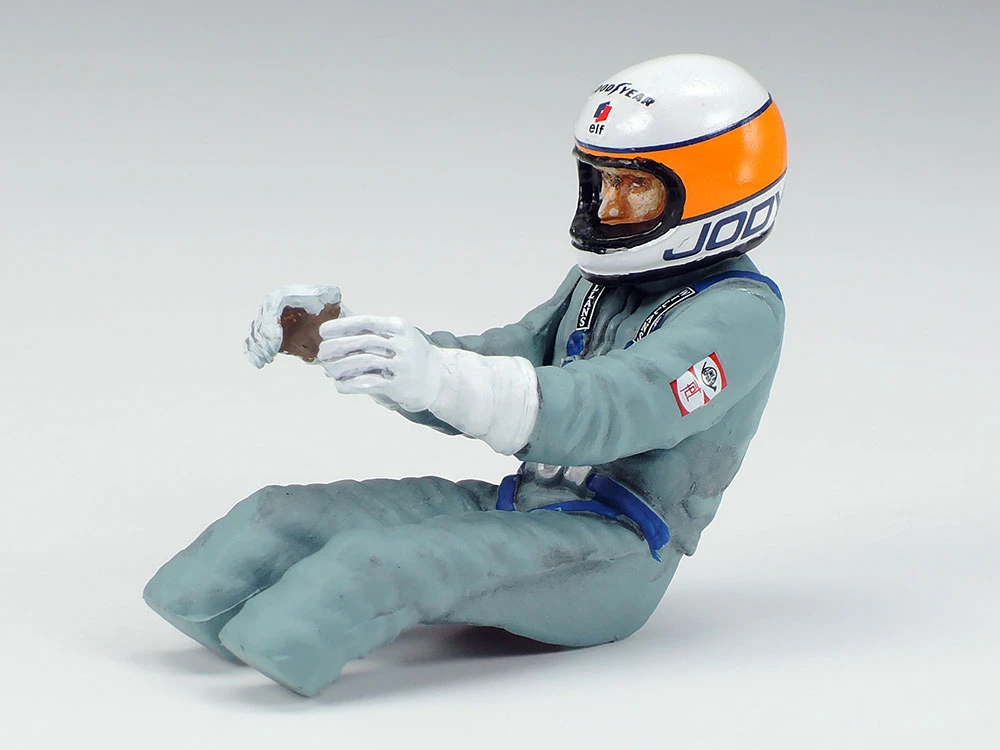
You cannot miss the attention to detail either. Photo-etched parts are used for the front and rear brake discs, triangular air funnel covers, intricate rear wing stays, end plates, and seatbelt buckles. Because they can reproduce thinness and edges that are difficult to express with plastic alone, they raise the sense of precision when completed to another level. Furthermore, sticker-type seatbelts are also provided, so it is configured to finish up to the cockpit without cutting corners. The P34 tends to steal your attention with the intense individuality of its six wheels, but as you carefully build it, highlights appear one after another, including the engine, suspension, brakes, and wing area.
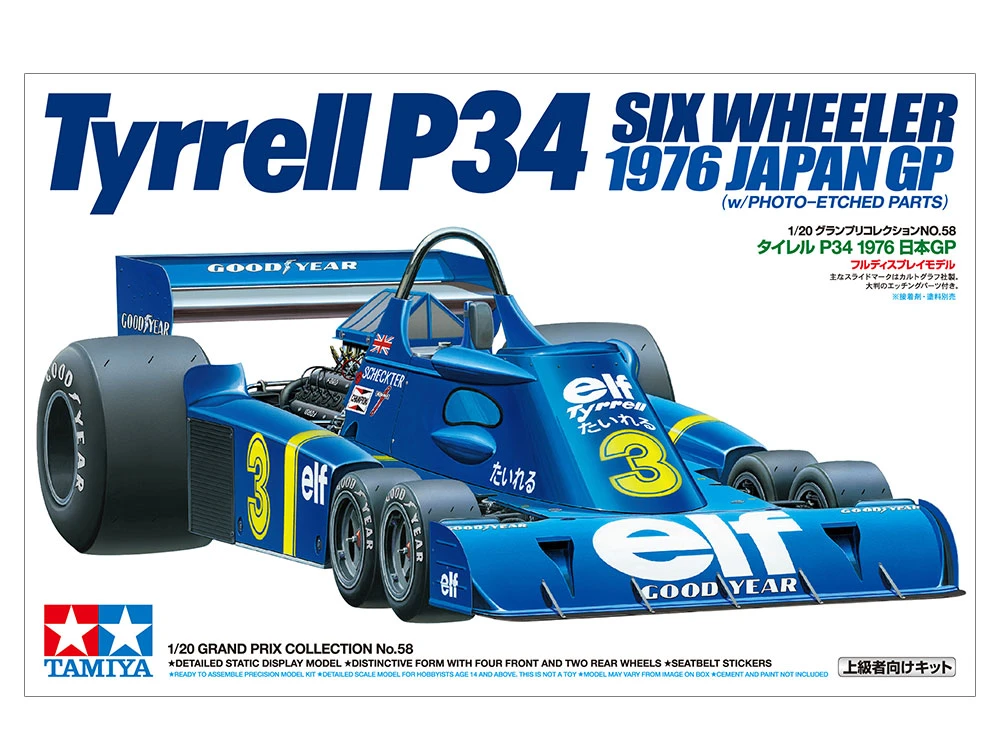
Even if you start with an interest through the entry point of ”an oddly shaped F1 machine,” by the time you finish assembling it, that impression might change. The capability that left results in the Swedish GP, the fierce battle played out in the 1976 Japan GP, the bold design of four front wheels, and the letters ”たいれる” symbolizing the Japan specification. Such stories and mechanisms are condensed into a single model. Beyond the fun of displaying and looking at the finished product, the charm of this kit is being able to imagine ”Why was such an F1 machine born?” while assembling each part one by one. Completing a unique existence left in F1 history step by step with your own hands. The ”1/20 Tyrrell P34 1976 Japan GP” is a model that allows you to savor such dense modeling time.
Plastic Model Kit - Grand Prix collection
Related Articles
-
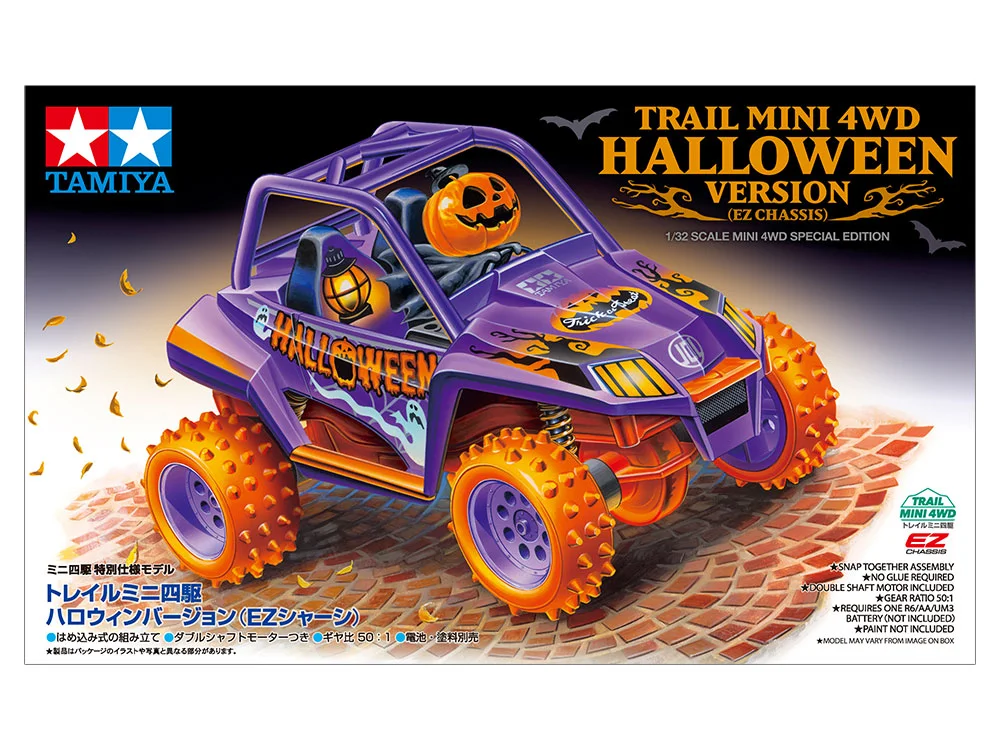 [Trail Mini 4WD] Limited-Time Halloween Version!? Easy-to-Assemble and Customizable Trail Mini 4WD Featuring a “Jack-o'-Lantern” Driver Arrives!2026-09-20 Saori
-
 【TAMIYA】1/35 US M24 Chaffee: Realistically Detailed Light Tank in 3D Model!2026-08-04 Saori
-
 【MAZDA】 Known as a pure sports car, Mazda's limited model that boasted popularity not only in Japan but also overseas has been turned into a plastic model!2026-07-01 Saori
-
 [Liberty Walk Series] The Aventador GT Evo, equipped with an ultra-powerful body kit, joins the lineup! The powerful body form and protruding wing are just too cool! Click here for the 1/12 scale LB-Silhouette Works Aventador GT Evo Ver.1!2026-06-23 Saori
-
 Recreating the popular model debuted at the 1983 Paris Show in its 2002 specification! Build the jet-black motorcycle bearing the name ”Ninja”! The 1/12 scale Kawasaki ZX900R GPz900R Ninja ’02 makes its debut!2026-06-17 Saori
-
 A kit of the Le Mans spec XJR-8 that competed in Round 4 of the 1987 WSPC! Resin parts added, along with special parts for fine details! Jaguar XJR-8 LM materialized in 1/24 scale!2026-06-01 Saori
Popular Articles
-
 【Utility Tractor】Born for rough terrain, its unique form is a fan favorite! The German RSO/01 Utility Tractor comes to life as a model kit featuring 1 driver figure and decals for 2 versions, including the 1944 Eastern Front!2026-09-13 Saori
-
 [ALDNOAH ZERO] The Earth Coalition Forces' Kataphrakt, ”KG-6 Sleipnir,” is materialized from the MODEROID series! This is also thoroughly supervised by mechanic designer I-Ⅳ, and decals can be selected from 4 types, 00–04!2026-09-05 Saori
-
 [Customer Showcase #11] Sweet Zero Fighter A6M2b Model 212026-09-02 Customer Showcase
-
 The night fighter Gekko, operated by the Imperial Japanese Navy, is now a 3D model! The popular aircraft that entered service in 1942 and flew through numerous battlefields and night skies is rendered in 1/72 scale!2026-07-29 Saori
-
[Trail Mini 4WD] Limited-Time Halloween Version!? Easy-to-Assemble and Customizable Trail Mini 4WD Featuring a “Jack-o'-Lantern” Driver Arrives!2026-09-20 Saori
-
 [Customer Showcase #10] 1:6 Tamiya Monkey bike2026-08-27 Customer Showcase